

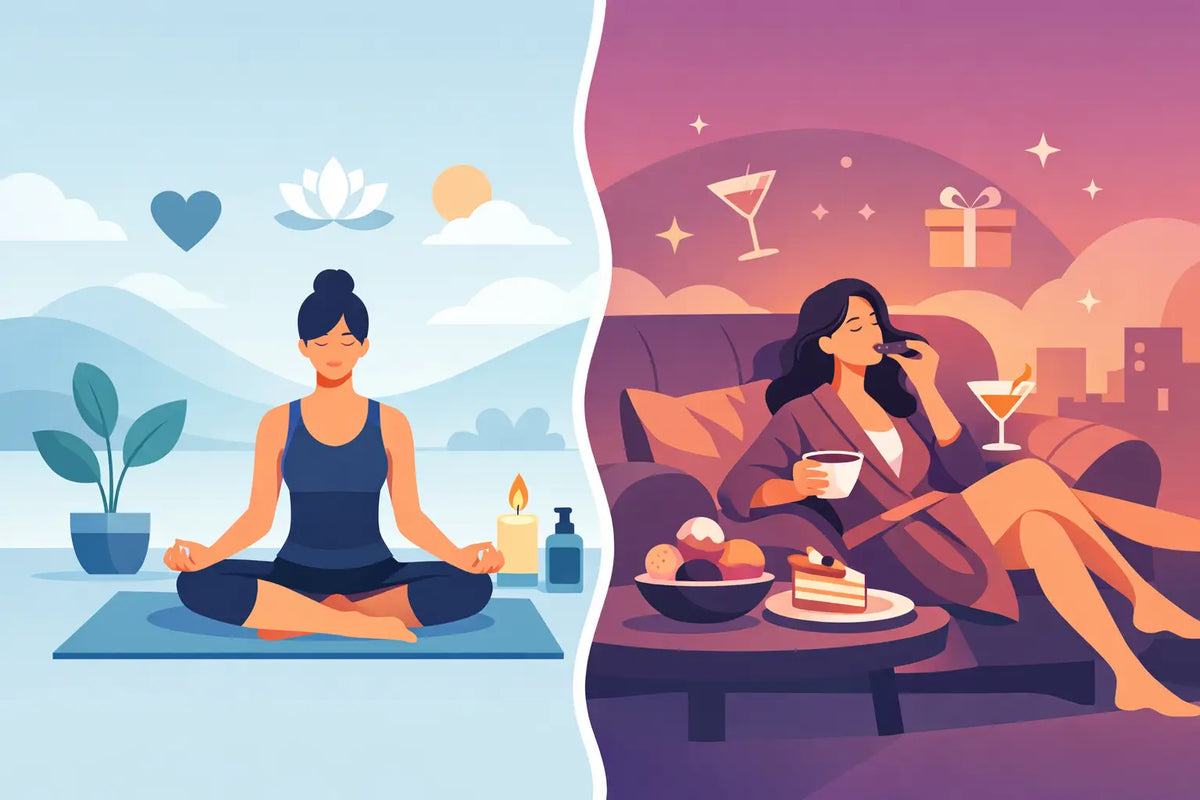
A sheet mask at 9 p.m. can be self-care. Ordering your third “treat” of the week because work was chaotic can be indulgence. Sometimes they look almost identical from the outside, which is why the self care vs indulgence conversation gets so blurry.
For women who love beauty, routine, and that little golden-hour feeling in the middle of a busy week, this matters. Not because indulgence is bad, but because not every feel-good habit leaves you feeling actually cared for. Some rituals restore you. Others just distract you for a minute and quietly ask for more.
Why self care vs indulgence feels confusing
Part of the confusion is aesthetic. A candle, a face mask, an online cart, a long shower, a luxury serum, a glass of wine, a spontaneous splurge - all of it can fall under the same visual mood board. Soft lighting. Calm music. Cute packaging. Main-character energy.
But the feeling after is usually where the truth shows up. Real self-care tends to leave you steadier, clearer, or more supported. Indulgence tends to give you a quick high, then disappear just as fast. Sometimes it even leaves a little guilt, a little depletion, or the sense that you were avoiding something instead of tending to it.
That does not mean indulgence has no place. It absolutely does. Pleasure is part of a good life. The issue is when we call every soothing or expensive choice self-care, even if it does not actually care for us.
What self-care actually is
Self-care is support. It is any action that helps you function, recover, regulate, or feel more like yourself over time.
Sometimes it looks luxurious. Sometimes it looks boring. Putting on SPF every morning is self-care. Taking off your makeup before bed when you are exhausted is self-care. Using eye patches before an event because it helps you feel refreshed and put together can be self-care too. So can saying no to plans, going to therapy, drinking water, or finally booking the appointment you have been putting off.
The common thread is not how pretty the ritual looks. It is whether the habit serves your well-being in a real way.
Self-care usually has a steadying effect. It supports your skin, your mood, your energy, your boundaries, or your confidence. It might not be flashy, but it helps future you.
Signs a habit is true self-care
A habit is probably self-care when it aligns with your needs, not just your impulses. It feels nourishing instead of numbing. It may require intention, and sometimes even a little discipline, but it pays you back.
A simple skincare routine is a good example. Cleansing, treating a breakout, hydrating your skin, and protecting it with SPF may not feel dramatic, but the ritual is caring for your skin barrier, your comfort, and often your confidence. It is a small daily promise that says, I am worth tending to.
What indulgence actually is
Indulgence is about pleasure, comfort, and desire in the moment. Again, that is not a character flaw. It is human.
The problem comes when indulgence becomes your main coping strategy. If every stressful day ends with a revenge bedtime scroll, a shopping spree, skipping your routines, or doing whatever feels good now with no regard for how you will feel later, that is usually not self-care. That is relief-seeking.
Indulgence says, I want this right now. Self-care says, I want to feel good not only tonight, but tomorrow too.
There is overlap, of course. A luxe body oil, a new lip product, or a Friday night LED mask session can be indulgent and still be self-care. The difference is whether the experience is adding something meaningful or simply helping you avoid discomfort for a few minutes.
When indulgence starts working against you
Indulgence gets tricky when it consistently pulls you away from what you actually need. Maybe you are tired, but instead of resting, you online shop. Maybe your skin is irritated, but you keep trying trendy products because the thrill of “fixing” it feels exciting. Maybe you call expensive treats self-care while your basics are completely neglected.
That is usually the tell. If the habit feels glamorous but leaves your skin stressed, your budget tighter, your sleep worse, or your mind more scattered, it may be indulgence wearing a self-care outfit.
Self care vs indulgence in beauty routines
Beauty is one of the easiest places to confuse the two because beauty rituals are supposed to feel good. And honestly, they should. Skincare can be functional and beautiful at the same time.
A healthy routine usually blends results with pleasure. You want products that do something, but you also want the experience to feel elevated enough that you will actually stick with it. That is where daily rituals shine.
Think about the difference between building a routine that supports your real needs and chasing a constant stream of novelty. If your skin is breakout-prone, a pimple patch that helps calm the moment and keeps you from picking is self-care. If you are buying your fifth “miracle” treatment this month because you are spiraling over one blemish, that is probably indulgence mixed with anxiety.
If an LED mask helps you slow down for ten minutes, gives you consistency, and supports your skin goals, it can absolutely be self-care. If you are using beauty purchases to manufacture a feeling of control while ignoring stress, burnout, or lack of sleep, the product is not the issue - the pattern is.
At its best, beauty self-care is not about excess. It is about intention. A few well-loved essentials that help you glow, reset, and feel ready often do more than an overflowing shelf ever could.
How to tell the difference in real time
The easiest question is this: what do I need right now, and what am I trying not to feel?
If the answer is that you need restoration, structure, calm, or confidence, self-care will usually move you toward that. If the answer is that you want escape at any cost, indulgence is probably in the driver’s seat.
Another useful question is what happens after. Do you feel more grounded, more comfortable in your skin, more prepared for tomorrow? Or do you feel overstimulated, avoidant, broke, guilty, or still unsettled?
You can also ask whether the habit is sustainable. Self-care tends to be repeatable. It fits into real life. It does not require a dramatic mood, a big spend, or perfect conditions. Indulgence is often more impulsive and harder to maintain without consequences.
None of this means self-care has to be strict or stripped of pleasure. Quite the opposite. The sweet spot is care that feels lovely and does something useful. That might be your makeup removing cloths at the end of a long night, your go-to SPF before heading out, or your favorite mask before an event when you want that fresh, rested glow. Happy Hour Beauty lives in that space - easy rituals that feel special without asking you to overcomplicate your life.
You do not have to earn softness
One reason women blur self-care and indulgence is because we are often taught to justify rest only when it is productive. If the bath helps recovery, it is allowed. If the serum improves your skin, it is allowed. If the purchase is practical enough, it is allowed.
But softness does not always need a spreadsheet. Sometimes something can be indulgent and still be completely fine. A little treat is not a moral crisis. The goal is not to eliminate indulgence. The goal is to stop using it as a substitute for care.
You are allowed to enjoy beautiful things. You are allowed to love rituals that feel polished, feminine, and a little luxe. You are allowed to want glow and comfort at the same time. Just be honest about what the moment is for.
Build rituals that give something back
The most satisfying routines are the ones that feel good now and still make sense later. They meet a need, support your real life, and add a little pleasure without becoming the whole strategy.
That might mean simplifying your routine instead of adding more. It might mean choosing products that help you stay consistent. It might mean trading random splurges for a few elevated essentials you actually use. Or it might mean noticing that what you really need is sleep, a boundary, a walk, a glass of water, or ten minutes alone before you reach for a “reward.”
There is no prize for the most disciplined routine, and there is no shame in loving indulgent moments. But if you want your rituals to truly care for you, let them be both beautiful and honest. The best self-care does not just feel good in the moment - it leaves you a little more glowy, a little more grounded, and a little more like yourself.


